
AI search optimisation
After years of obsessing over SEO, you’ve got your university’s website to rank exactly where it should on Google. Your hard work means that prospective students are easily finding and clicking through to your course pages.
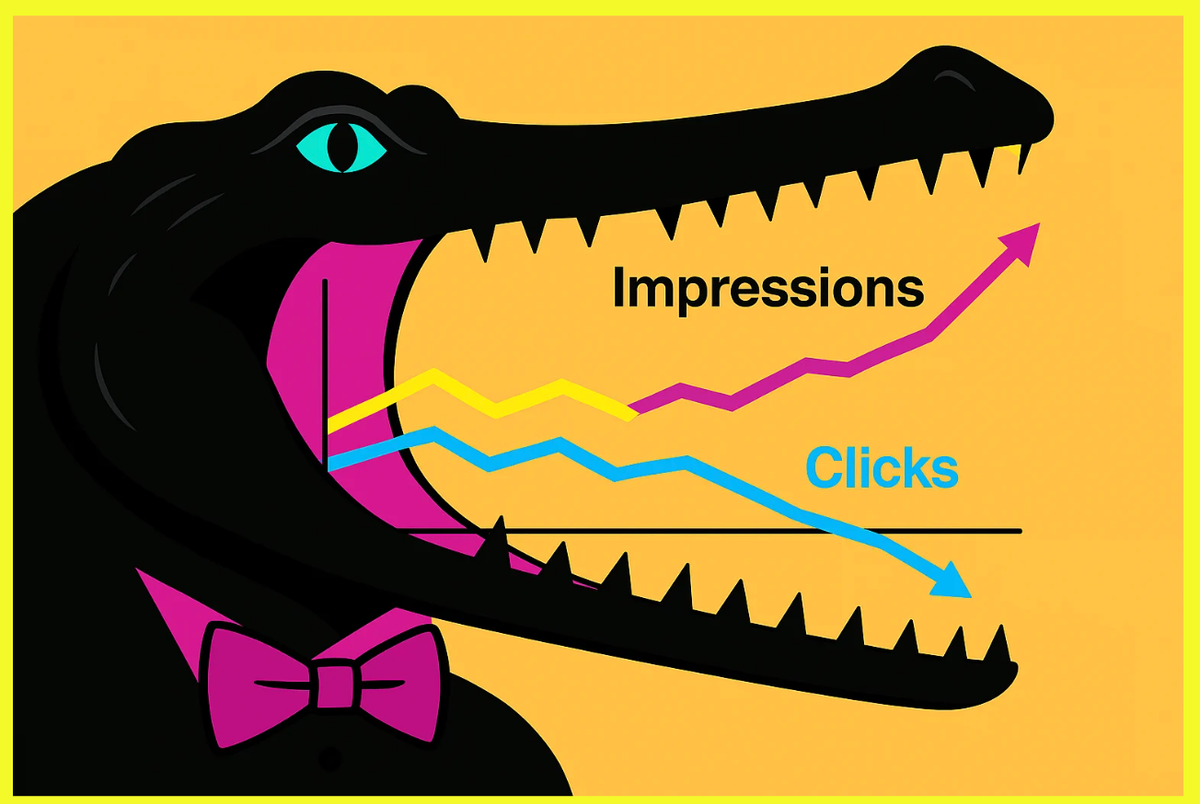
But, wait. You pull your usual monthly analytics report and things look … weird. Rankings are fine, maybe even improving. But something doesn’t add up: impressions are climbing, yet clicks are declining.
You dig a bit deeper. Under referral traffic sources, you notice visits from chatgpt.com or perplexity.ai. Meanwhile, Google Search Console’s generative AI performance reports show whether your pages are appearing in AI Overviews and AI Mode. These are different views of how AI is influencing discovery
Don’t panic!
Some of those ‘missing’ clicks may have become visits through another channel. Others may never happen: prospective students can now get answers without visiting your website. The question is whether your institution features in those answers.
AI has changed search
Search engines and AI assistants increasingly combine information from multiple sources into a single answer. That answer may appear above traditional search results or appear inside a conversation, with links to some of its sources. People do not always need to visit a website to find what they need. When a search ends without a click, it is known as a zero-click search. AI answers contribute to this behaviour, alongside familiar features such as snippets and instant answers.
SparkToro’s analysis of Similarweb data found that 68% of US Google searches ended without a click in the first four months of 2026. That does not mean 68% definitely received an AI answer, but it illustrates how much research can happen without a website visit.
Answers delivered directly in search results can contribute to rising impressions and falling clicks. This widening gap is sometimes called the ‘crocodile effect’. Of course the pattern alone does not fully establish the cause – changes in query mix, rankings and search-result layouts also need looking at.
The upshot? You’re not just competing for human clicks, but for machine citations. Fail to sort your site’s AI search optimisation and you could be cut out of the conversation entirely. AI assistants like ChatGPT, Perplexity and Gemini will show other content and recommend competitors instead.
In the education sector, that’s not a hypothetical. It’s already happening, hidden behind rankings that still look perfectly healthy. Not being cited doesn’t just cost clicks: it signals to both AI models and human audiences that we’re less relevant, whether or not that’s true.
A case study published in Search Engine Land illustrates the gap. Across ten websites, the top ten organic pages captured 55% of organic sessions but only 29% of LLM referral sessions. The sample was limited, but the finding is useful: your strongest pages in traditional search may not be your strongest sources of AI referrals.
So what does that mean for all your hard-fought efforts to improve your site’s SEO?
GEO is still evolving
Alongside SEO, there’s a new initialism in town – GEO. Generative Engine Optimisation refers to the full range of optimisations you make to become a point of reference for AI tools, so that they cite, summarise and recommend your content inside their platforms’ generated answers. It includes working towards accurate mentions, citations and recommendations. Much of that work overlaps with established SEO, content strategy and digital PR.
‘If traditional SEO is Gen X, Generative Engine Optimisation (GEO) is its Gen Z child. Like many of its generation, GEO is deeply sceptical of anything that smells like an obvious sales pitch or keyword-stuffed performance. Authenticity and evidence matter more than claims dressed up nicely.’ George Chilton, Creative Managing Director, Hubbub Labs
This means your website needs to be understood and trusted, not just found. The benchmark? E-E-A-T (Experience, Expertise, Authoritativeness and Trustworthiness), brand mentions, research, and citations and recommendations – not just rankings. It’s not a universal AI scoring system though; it also tracks accurate mentions, citations and recommendations for relevant student questions.
You need to be asking: can an AI system find, understand and recommend my site?
It’s time to get ready for AI search optimisation
The good news is that robust technical and on-page SEO is still a decent foundation. It means crawlers find your pages, understand their structure and identify what each page is about. But AI search optimisation tackles another problem: getting your website, content and third-party sources ready so that it can provide an accurate and comprehensive answer to your AI clients.
When doing this, we find it useful to consider the following questions:
Are we informing the answer?
This is about accessibility and legibility, identifying whether an AI can actually read your content. For this, check your site’s technical accessibility: Can OAI-SearchBot and Claude-SearchBot access your public content or are they being unintentionally blocked?
These are distinct from training crawlers such as GPTBot and ClaudeBot: allowing search access and permitting model training are separate decisions.
Conduct a content depth audit to ensure you aren’t just ranking, but also providing the comprehensive answers AI needs. Prioritise clear, current facts about fees, attendance, entry requirements, accreditation and placements. Add detail where it helps students make a decision.
Are we appearing in the answer?
Don’t wait for analytics. Manually test this. Combine analytics with a repeatable set of tests. Ask the questions students actually raise in enquiries, record which institutions and sources appear, and check the facts. Repeat across platforms and over time; a single answer is only a snapshot.
Ask ChatGPT, Perplexity and Gemini the actual questions prospective students ask, such as ‘Best universities for nursing in the UK?’ or ‘Which unis offer flexible PR masters?’ If you aren’t appearing or your description is inaccurate, you have a visibility gap.
Are we being recommended by the answer?
This is the ‘trust’ layer. Subjective AI judgement determines if you are the answer. Audit your evidence base: accreditation, staff credentials, published research, case studies and third-party reviews. Does your content provide the definitive proof an AI needs to cite you as the top (or recommended) option – and give accurate reasons? Audit the evidence behind those reasons, including accreditation, delivery arrangements, outcomes and student experience. Strong evidence supports a recommendation, but cannot guarantee one.
We think of these questions as a ladder to climb rather than a checklist.
Each stage depends entirely on the one before it: you can’t appear in an AI’s answer without first informing it and you can’t be recommended without first appearing. The climb also gets progressively harder and more valuable:
Informing requires accessible, useful and current information. Appearing requires the institution to be identified as relevant to the question. A credible recommendation needs evidence of fit. Technical access helps, but none of these outcomes is purely a technical task.
Have a look at how this might work in practice:
| What the marketer tests | What a gap might look like | What to improve | |
| Are we informing the answer? | Can a tool find clear, current information about study pattern, accreditation, placement requirements, location, fees and entry criteria? | The course page says ‘flexible study’ but doesn’t note which days require attendance. Accreditation isn’t clear (it’s buried in a PDF), and placement support is described vaguely. | Put the facts on the course page in plain language. Answer the questions students actually ask using an FAQ, including constraints and caveats. |
| Are we appearing in the answer? | When several tools answer the student’s question, does the university feature? Do they link to its course page, another source or nothing? | The university has a suitable course but it doesn’t appear in the shortlist. Or it appears, but the answer gets the facts wrong. | Investigate the sources and tools used, correct unclear or outdated information (it’s coming from somewhere), and make the relevant course details easier to find and verify. |
| Are we being recommended by the answer? | When the student adds their priorities, does the university emerge as a suitable option, with accurate reasons? | The university is listed but another is favoured because it clearly explains evening attendance and placement arrangements. Or the tool recommends Hubbub’s client for accreditation it does not hold. | Supply verifiable evidence for the actual decision criteria: accreditation status, timetable, placement arrangements, outcomes and student experience. Correct misleading third-party listings where possible. |
This is why AI visibility needs attention alongside traditional rankings. The underlying work often overlaps with SEO, but the outcomes you are checking extend to inclusion, accuracy and suitability within generated answers.Informing, appearing and recommending each have to be earned on their own terms.
Why all this matters to university digital marketers
Mastering AI search optimisation is now essential for university digital marketers. An EAB survey of more than 5,000 US high-school students found that 46% used AI tools during their college search. Conducted in October–November 2025. It also found that 18% had removed a college from consideration based on information surfaced through AI-generated search results.
If you aren’t part of the conversation between your prospective students and AI, your content’s quality elsewhere won’t matter.
However, the interesting thing is that the visitors who do find you through AI tend to be of a different calibre altogether. According to Semrush, visitors who come via an LLM convert at roughly 4.4x the rate of traditional organic visitors.
Think of these LLM visitors as ‘pre-briefed’ candidates. They aren’t just aimlessly browsing; they are arriving on your course pages already familiar with your value proposition, effectively skipping the ‘awareness’ phase of the marketing funnel and moving straight to consideration.
Yes, the volume is tiny right now (Knotch puts LLM traffic at no more than 0.13% of total visits) but that sliver is doing disproportionately heavy lifting on conversions. According to the same research, these visitors don’t just convert better, they stick around longer and dig deeper into the site than the average visitor. They may be a small crowd, but they have a big appetite for your content.
Thankfully, education institutions already hold much of the evidence students need: course specifications, accreditation records, research, staff expertise and graduate outcomes. The opportunity is to make that evidence easy to find, current and consistent across your website and relevant external sources. Having the information is only the starting point.
So what does chasing this opportunity actually look like? A mix of technical groundwork, on-page clarity and old-fashioned PR, aimed at three things:
- Feeding the machines the right signals. Producing content in formats LLMs actually like and making sure you’re sitting in the sources they go back to.
- Owning emerging topics early. Getting there before a subject goes mainstream, so you’re the name already cited when everyone else starts asking.
- Building multi-channel authority. PR, influencer and off-site presence working together, not just your own website shouting into the void.
None of that requires beating the entire sector to it – just beating most of it. Some estimates say that only 30% of US institutions actually have an AI search strategy in place, while 60% haven’t got past ‘exploring’.
Which means the bar for standing out is temporarily low. Right now, out-doing most of your competitors is a lot easier than trying to out-rank them on Google ever was.
Don’t wait for the ‘crocodile’! Test your AI readiness today
The best time to tackle this is right now – don’t wait until you spot those changing website metrics to check the AI readiness of your site. We can help you get ahead of the changes and determine exactly what you need to do to optimise your website for AI search.
Our free AI Search Health Check examines up to 20 pages of your site and gives you a prioritised action plan for improving your AI readiness.